Your Cart is Empty

How do you avoid razor burn on legs? What actually causes it? Will a different razor help? What should you really be shaving with? We hear these questions constantly — so we put together this guide to answer all of it, with real steps you can start using today.

No matter how many creams you try or how much you spend on a fancy razor, razor burn always seems to find a way back. Annoying? Yes. Inevitable? Not really — once you know what's actually causing it.
There are three usual suspects: your skin, your razor, and your shaving cream. Let's break down each one.
Two things about your skin make razor burn more likely — how hydrated it is, and how much dead skin has built up.
Dry skin has an uneven texture, which makes it easy for a razor to snag and catch, leading to burn, nicks, and irritation. The same goes for a buildup of dead skin cells (gross, we know) — it creates the same rough, uneven surface that a blade can catch on.
Next up: the tool doing the actual work. There's no shortage of razor options out there, from bare-bones single blades to five-blade models with more features than your phone. Any of them can work well — but what matters most for avoiding razor burn is simple: how sharp the blade is.
Last but not least — your shaving cream or gel. If that surprises you, you're not alone; most women assume their shaving cream is helping, not hurting.
The truth is, most shaving creams and gels promise razor-burn protection they can't really deliver.

Curious about the differences between shaving cream, gel, and shave syrup? Read our guide: Best Shaving Cream Or Gel For Women
Shaving cream — the most popular option — is light, foamy, and easy to rinse, which makes it simple to see where you've shaved. But it doesn't provide much real moisture or protection.
Shaving gel is thicker and offers a bit more cushion, but it's harder to rinse off and can clog your razor, which raises your odds of nicks and cuts.
Neither is really built to prevent razor burn. (More on what is, in a minute.)
These two get lumped together all the time, but they're not the same thing — and knowing which one you're dealing with changes how you treat it.
Razor burn shows up almost immediately after shaving. It looks like flat, red, blotchy patches and usually feels itchy or like a mild sunburn. It's caused by surface-level friction and irritation from the blade — think dry shaving, old blades, or pressing too hard.
Razor bumps show up later, as your hair starts growing back. They look like small, raised, pimple-like bumps, and they happen when a shaved hair curls back into the skin instead of growing straight out (an ingrown hair). Razor bumps are more common on coarse or curly hair and can stick around for weeks.
The good news: the same prevention routine — proper prep, a sharp blade, and the right product — helps cut down on both.
Step one for avoiding razor burn? Keep your legs exfoliated and moisturized. These two habits even out your skin's texture over time, which means a closer shave and less irritation.
Exfoliation
Use a gentle brush or loofah and work it over your skin before you shave. Do this in the shower or bath — the steam softens skin and makes exfoliating more effective.
Moisturizing
After you shave, always follow up with a soothing lotion. Look for something paraben- and fragrance-free with real hydrating power, like our Post-Shave Melted Body Butter Moisturizer.
Simply put — yes. You know that feeling when you first use a brand-new razor and it just glides? That's how every shave should feel. A sharp blade means less catching, less dragging, and a lot less razor burn. A dull one means the opposite.
If neither cream nor gel actually prevents razor burn, what does?
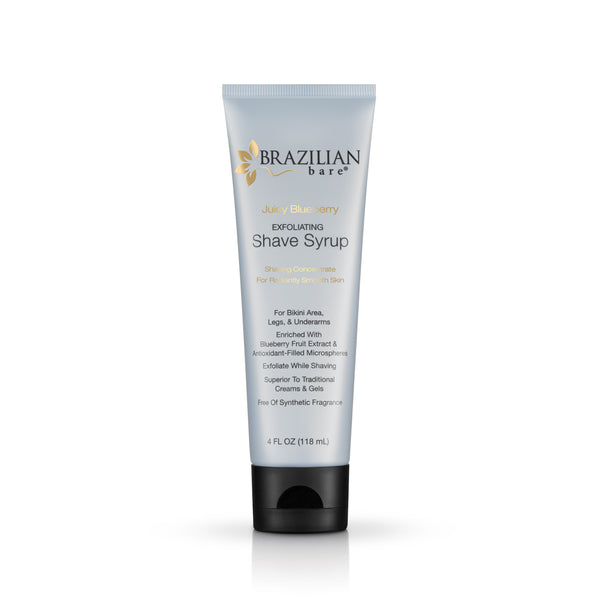
Shave syrup — specifically, Brazilian Bare Shave Syrup.
It's not a cream. It's not a gel. It's a different category entirely — a moisture-rich, antioxidant-enriched formula that's gentle on skin and dermatologist recommended.
The translucent color makes it easy to see exactly where you've shaved, so there's less guesswork and fewer missed spots (or repeat passes, which are a major cause of irritation). It creates a smooth, protective layer that lets the razor glide instead of drag, while hydrating your skin at the same time.
Here's how it all comes together — your skin, your razor, and your shaving product, working as one routine instead of three separate guesses.
Step 1: Get Scrubbing
Exfoliate first, whether that's dry brushing or a loofah in the shower. This clears away dead skin so the razor can glide instead of snag.
Step 2: Start Fresh
If your razor blade has seen better days, toss it. A fresh, sharp blade is one of the simplest ways to avoid burn, nicks, and cuts.
Step 3: Skip The Cream, Reach For The Syrup
Swap your usual cream or gel for Brazilian Bare Shave Syrup — the protective layer that's actually built to prevent razor burn, not just mask it.
Step 4: Moisturize
Once you're done, lock in moisture with a good post-shave lotion. This is what helps existing irritation heal and keeps new razor burn from showing up next time.
Prevention is the goal, but if razor burn has already shown up, here's how to calm it down:
Most razor burn clears up within a couple of days on its own. If it's still hanging around after a week, or looks infected, it's worth checking in with a dermatologist.
How long does razor burn on legs last?
Typically 2–3 days for mild cases. More stubborn razor burn can take up to a week to fully clear, especially if the area keeps getting irritated (tight clothing, re-shaving too soon, etc.).
Why do I only get razor burn on certain parts of my legs?
Areas like the ankles, knees, and inner thighs have thinner, more sensitive skin and more contours for a razor to catch on — which is why razor burn tends to show up there first.
Can shaving cream actually cause razor burn?
Indirectly, yes. Most creams and gels don't provide enough of a protective barrier, which means more friction between the blade and your skin — one of the leading causes of razor burn.
Is razor burn the same as an allergic reaction?
No. Razor burn is physical irritation from the blade itself, while an allergic reaction (to a product ingredient, for example) usually comes with more widespread itching, hives, or a rash unrelated to the exact area you shaved.
Do I need to stop shaving completely if I have razor burn?
Just on the affected area, until it clears. Shaving over irritated skin will usually make it worse and slow healing.

Click Here To Download & Share The PDF
Want To Get Rid Of Razor Burn For Good?